Our technology
Disaster Recovery & Business Continuity
Keep critical systems recoverable, available, and ready when disruption happens.


Keep critical systems recoverable, available, and ready when disruption happens.

CloudLake helps organizations maintain a dependable recovery environment for systems that cannot remain offline for long. Critical workloads can be backed up, replicated, and prepared for recovery in an in-country cloud environment, reducing dependence on distant infrastructure while supporting local data residency requirements. This gives IT teams a practical path to protect applications, databases, files, and virtual machines against outages, data loss, operational errors, cyber incidents, or infrastructure failure. With scheduled backup and snapshot capabilities, recovery points can be aligned with business priorities, retention policies, and compliance expectations. The goal is simple: when disruption happens, your organization should not be starting from zero. Your recovery environment should already be in place, ready to support faster restoration and continuity of essential operations. Our platform supports automated creation and retention of snapshots and backups for disaster recovery policies.
A continuity plan is only valuable if it can be executed when the business needs it most. CloudLake supports disaster recovery planning by giving organizations a cloud environment where recovery workflows can be designed, tested, and improved over time. Teams can define backup schedules, retention windows, and restore strategies based on the importance of each workload, rather than applying one generic policy to every system. This makes it easier to separate mission-critical applications from lower-priority systems and align recovery objectives with actual operational risk. Whether the requirement is frequent snapshots, scheduled backups, or longer retention for audit and compliance purposes, CloudLake provides the foundation to make recovery more structured, repeatable, and measurable. Instead of treating disaster recovery as a last-minute response, organizations can make it part of normal IT operations.
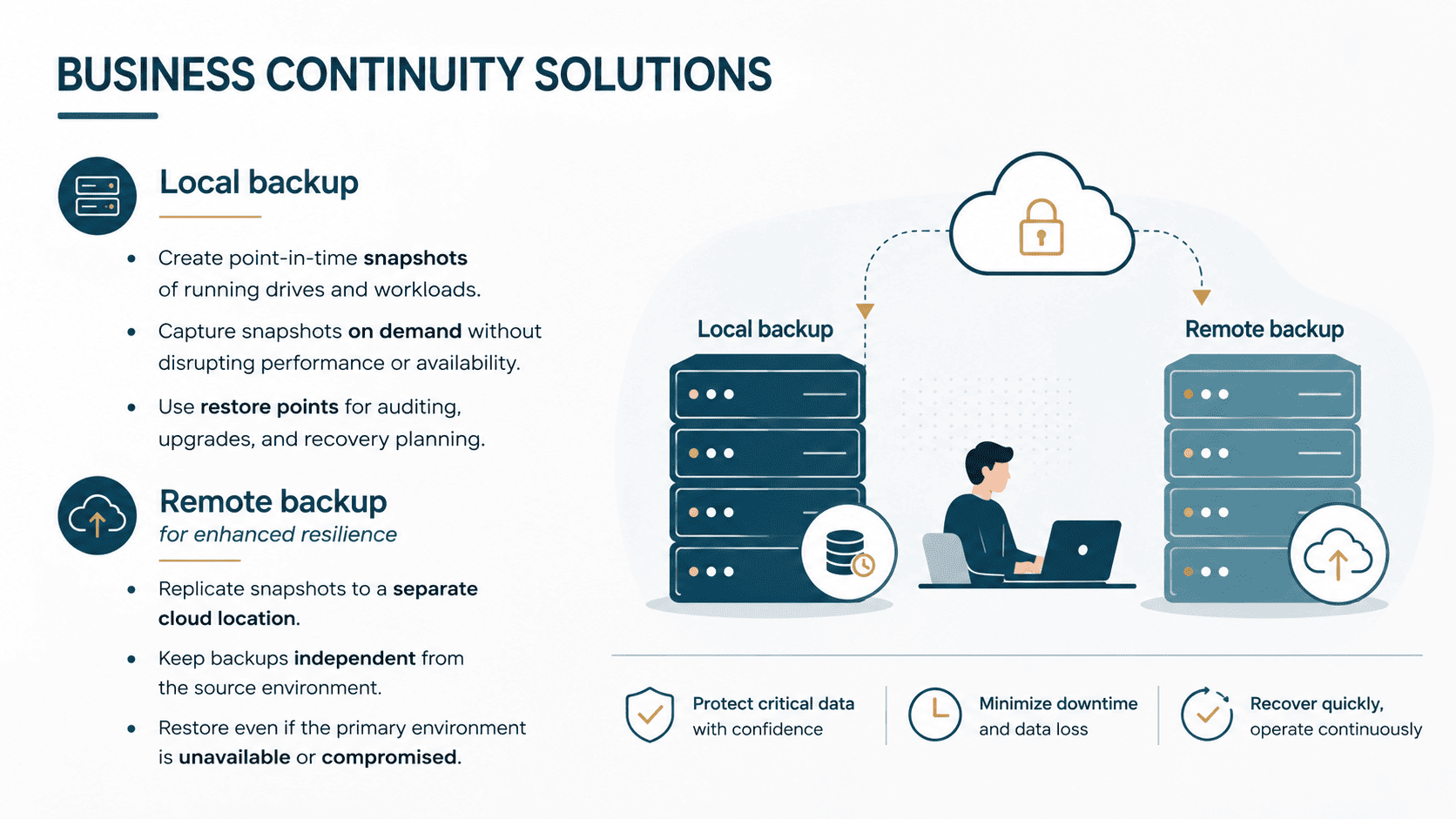
Business continuity is not only about restoring systems; it is about keeping the organization functioning during disruption. CloudLake provides a local cloud foundation that helps customers maintain access to essential workloads, preserve operational control, and support users from within the country. This is especially important for government agencies, financial institutions, gaming operators, healthcare providers, and enterprises that need to balance uptime, data governance, latency, and regulatory expectations. By hosting recovery environments locally, organizations can reduce the operational friction that comes with offshore-only recovery strategies. CloudLake helps customers prepare for incidents with a practical continuity model: protect the workload, define the recovery path, test the process, and keep critical services closer to the users and teams that depend on them.

Track cloud infrastructure health, resource usage, alerts, and service conditions so issues can be identified before they affect operations.
Get local assistance for troubleshooting, escalation, coordination, and response when infrastructure concerns require urgent attention.
Support day-to-day cloud administration, configuration reviews, optimization, and environment management with a team familiar with your setup.

Define recovery priorities, target restoration times, and the systems that must come back online first during an outage.
Use scheduled and on-demand snapshots to create recovery points before upgrades, incidents, or unexpected failures.
Keep recovery environments closer to Philippine users and operations to reduce dependence on offshore-only recovery paths.
Review current systems, dependencies, risks, and workload requirements to identify what should move first and what needs preparation.
Move workloads through a structured migration path with clear sequencing, testing, cutover planning, and coordination across teams.
Refine resource allocation, security settings, backup policies, and operating procedures after migration to improve long-term cloud performance.
Use shared in-country cloud infrastructure for scalable applications, development environments, portals, analytics, and business systems that need local hosting without dedicated infrastructure.
Deploy dedicated cloud environments for sensitive workloads that require stronger isolation, tighter governance, customized controls, or organization-specific infrastructure design.
t public cloud, private cloud, and existing infrastructure through secure local network paths so workloads can run where they fit best.
Configure compute, memory, storage, and networking independently so environments match actual workload needs instead of fixed package limits.
Avoid over-provisioning by aligning cloud resources with application behavior, usage patterns, performance requirements, and growth expectations.
Adjust capacity as workloads change, whether you need more storage, higher memory, additional compute, or network-specific configurations.

Run AI, analytics, simulation, and high-performance workloads on GPU-enabled infrastructure without investing upfront in dedicated hardware.
Scale GPU resources based on project stage, workload size, model requirements, and utilization instead of locking teams into fixed on-premise capacity.
Keep AI workloads closer to local users, systems, and data governance requirements while supporting experimentation, training, and deployment.

CloudLake serves enterprises, government agencies, and regulated industries that need secure, locally hosted cloud infrastructure for critical workloads, data residency, and operational resilience.
CloudLake helps government agencies host digital services, records systems, and public-sector workloads in-country, supporting data sovereignty, service continuity, and stronger control over public data.
CloudLake is suitable for sectors such as financial services, gaming, healthcare, utilities, and other compliance-sensitive industries that require local hosting, governance, security, and resilience.